

The tidal wave of travel cancellations that came along with the coronavirus pandemic upended usual accommodation patterns and put heavy pressure on occupancy levels across the world.
Portugal was no exception, with its always-bustling capital now much quieter than usual and a large number of its hotel rooms and vacation rentals remaining dormant.
Exclusive statistics on the status of the short-term property market provided to Via News show that Lisbon has seen a large drop in occupancy, and while the industry is in better shape than it was early in the pandemic, it is still in crisis.
The year started well, with occupancy rates in Lisbon close to or almost the same as the previous year. In January 2020, the registered temporary lodging accommodations sit at 40%, compared to 43% in the same period last year.
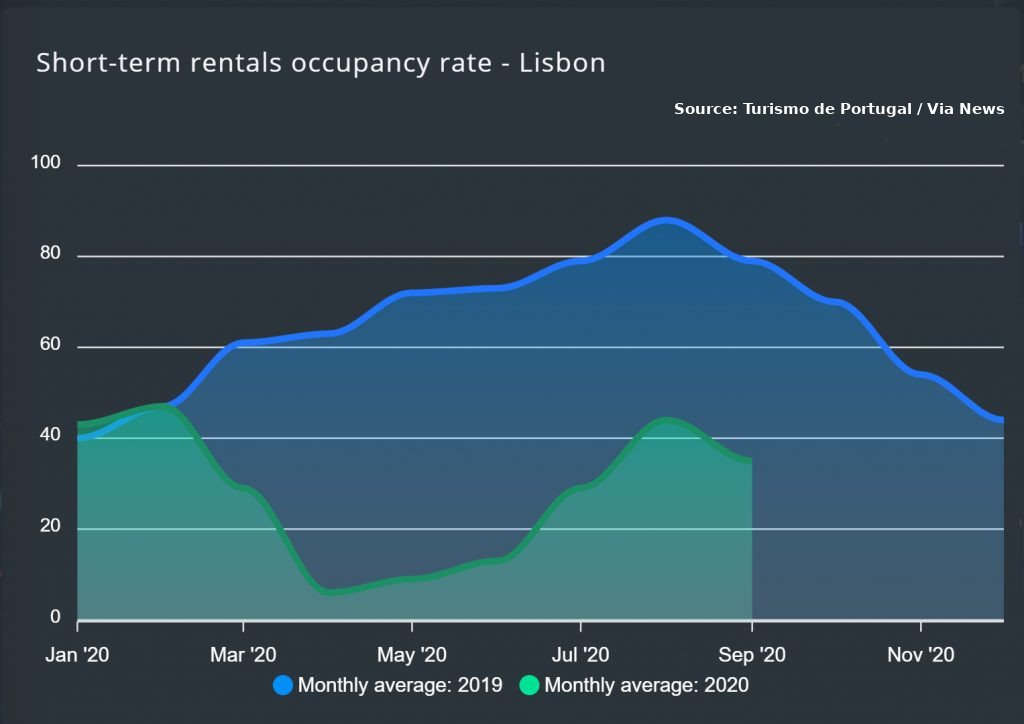
In February, the short-term rentals were at 47% average occupancy, just as they were in 2019. However, border closures and national restrictions to curb the spread of the respiratory disease began to take a toll on the hospitality sector in March.
The occupancy rate of Airbnb-style rentals in Lisbon in March fell from 61% in 2019 to 29%, ushering in a period of fear and uncertainty for property owners.
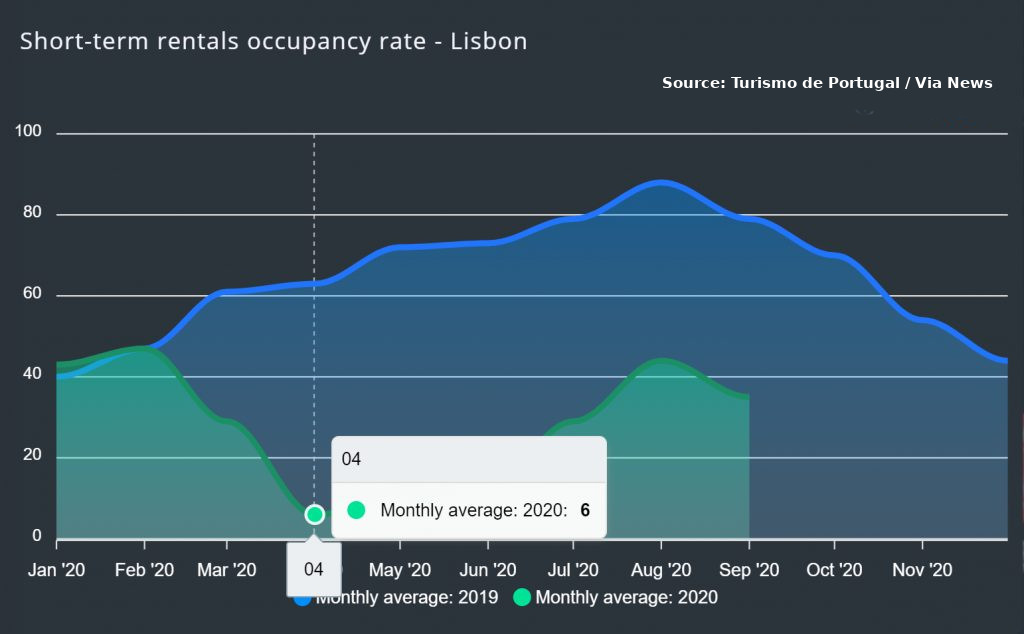
Things went downhill further in April when the Portuguese government rolled out a strict lockdown to combat the COVID-19 outbreak, which shut most non-essential services and restricted travel and movement. Only 6% of the listed short-term accommodations were occupied, compared to 63% in April last year.
The situation remained almost unchanged in the following month, with an occupancy rate of 9% compared to 72% in May 2019.
Read more: COVID-19 Stifles Supply of New Short-Term Rental Listings in Portugal
Slight Improvement in Demand
The occupancy data began to show a slight recovery in June, July, August, and September after Portuguese authorities announced a sector-by-sector plan in late April to gradually lift quarantine measures.
The occupancy rates of 13%, 29%, 44%, and 25% were registered in June, July, August, and September, respectively. This is while short-stay rentals were at 73%, 79%, 88%, and 79%, respectively, in the corresponding months of 2019.
Indeed, the rates are gradually recuperating, but there is no denying the fact that the sector is still in the grip of uncertain demand expectations heading into winter.
The unclear prospects for the holiday accommodation market are fueled by the Portuguese government’s recent decision to introduce and implement a new set of restrictions due to a resurgence of contagion.
Portugal has so far recorded a comparatively low 161,350 infections and 2,740 deaths, according to the figures published by the Johns Hopkins University on November 6.
The situation is particularly better than in hard-hit neighboring Spain where 1,306,316 people have been infected and 38,486 have died of the novel virus.
However, Portugal had to gear up for a new battle after it recorded more than 1,000 new coronavirus cases in a single day on October 8 for the first time since April.
Ongoing Contest
As the industry struggles to recover, the never-ending competition between hotels and short-term rentals finds both trying to persuade travelers that their rooms are virus-free, their offerings are social-distancing compliant, and their terms and conditions are fair.
Read more: Short-Term Rentals Outperforming Hotels in Pandemic Era
According to a recent piece on the New York Times, “social distancing, hygiene, and refund policies may be the new game changers.”
Regardless of who wins this battle, it is hoped that the ultimate winner will be Portugal’s vital tourism sector, which has offered a tremendous contribution to the national economy throughout the years.