

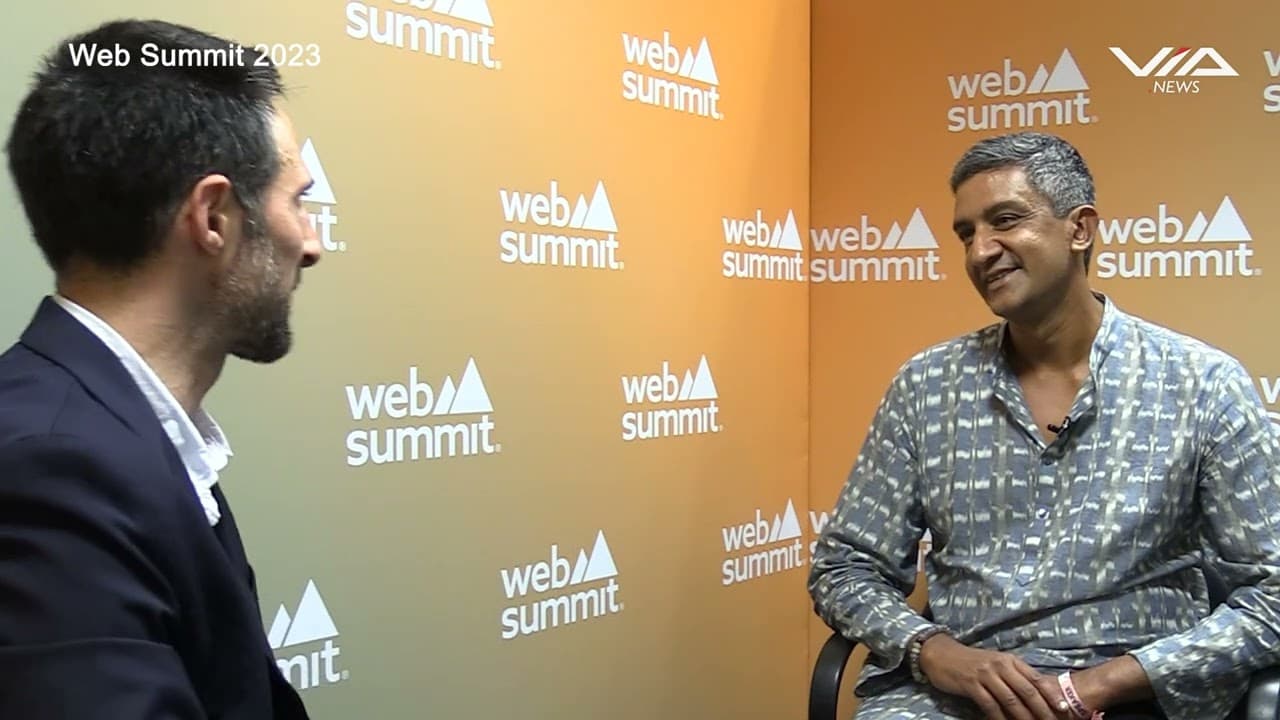
This interview was recorded about 2023.
Ramesh Srinivasan, a professor at UCLA's Graduate School of Education & Information Studies who leads the Digital Cultures Lab, says the economic benefits of artificial intelligence should not be concentrated among a small group of investors. Speaking to Via News at Web Summit, he argued that the technology is built on public investment and personal data, and that the people who supply both deserve a share of the value.
Srinivasan said his keynote at the event focused on the economic issues raised by what he called a digital takeover of daily life. He set out the case against a model in which gains accrue to a few. "So instead, I challenge us to think about how technologies of all kinds can be good for businesses, but not in a way that zeroes that supports like a couple of investors and the rest of us are sort of almost like in a new feudal class."
Built on public data and public investment
Srinivasan distinguished today's large language models from earlier forms of artificial intelligence, which were built around logic or specific domains such as vision or chess. The current systems, he said, mimic patterns through probability and correlation. "The reason they're able to do that is because of the backdrop of them having astronomical amounts of our data."
He tied that to a wider point about who pays for the digital economy. The internet began with American taxpayer investment, he said, and large platforms depend on public goods such as roads. Large language models, in his view, have no relevance without personal data. He did not want to diminish the value of the services these companies provide, but said they rest on the public. If companies build models that are bad for working and middle class people, he argued, they harm their own base, because their model relies on the value of that data.
Income, benefits and new jobs
Asked whether job displacement will be a concern, Srinivasan said it is, if society does not think about what work will look like. He framed the issue as economic security rather than employment alone. The options he said he put forward in his talk included universal basic income, payments to people for their data through micropayments, and portable benefits that would let gig workers combine income from several employers to pay for health insurance. He also pointed to new roles that could emerge, naming data ethicist, archivist and cultural information designer.
He said regulation is critical but cannot be the only route, given the difficulty of securing agreement among American politicians. Corporations can be pushed to experiment, journalists can draw attention to the issues, and social movements have historically changed societies. He said he was not proposing a revolt against AI, but that there is power in populism. He also noted that hype cycles come and go, citing Clubhouse and NFTs, and urged a longer view that puts human beings and their economic security first.
"Europe can lead the way in illustrating what a balanced digital world can look like, and then we in the US can look to Europe for some answers."
Europe's opening
Srinivasan said the United States has done little on these issues at government level, while Brazil and the European Union have offered examples. He said he had recently spoken with the Bulgarian minister of technology, who he said is thinking seriously about where the technology is heading. On Europe's position, he rejected the idea that the region is falling behind. "I actually think even though in Europe, I often hear from my European friends that they feel behind or like this is all being dominated by the US and China, I just remind you all that having great policies that support your populations is innovation, and if anything, we look up to you all, or at least I do."
He contrasted China, where he said state and corporations move in lockstep within a surveillance driven model, with the United States, which he described as entrepreneurial but polarized. Europe, he said, could stand for something different.
Capable systems, but not human
Looking ahead, Srinivasan expects continued progress. "I mean, look, those models, the large language models are going to be better and better at simulating and approximating human activity and human expression, because the more data they get and the more refinement they create to the algorithms and the neural networks that they use, the more convincing it will be." He added a limit to that view: "However, these AI systems do not work like human beings do on any level at all."
He rejected what he called the Terminator scenario, associating it with figures such as Elon Musk and Yuval Harari. He called it alarmist and said it shields corporations from responsibility to workers, consumers and the wider public, including for ensuring that their algorithmic systems are not discriminatory. He said the systems can help with climate change, for example by predicting extreme weather and managing resources, and that the opportunity is to double down on what it means to be human.
His next steps for governments, businesses and the public started with literacy: public education campaigns on how these systems work, followed by regulatory action and pressure on private corporations. He cited Microsoft investing heavily in OpenAI and then cutting thousands of jobs within days. He did not say the two were linked, but said it expresses something. Corporations will follow their valuation, he said, and the rest of society has to check that power.
Watch the full interview
Interview by LM Salvado (Miguel Salvado) for Via News.