
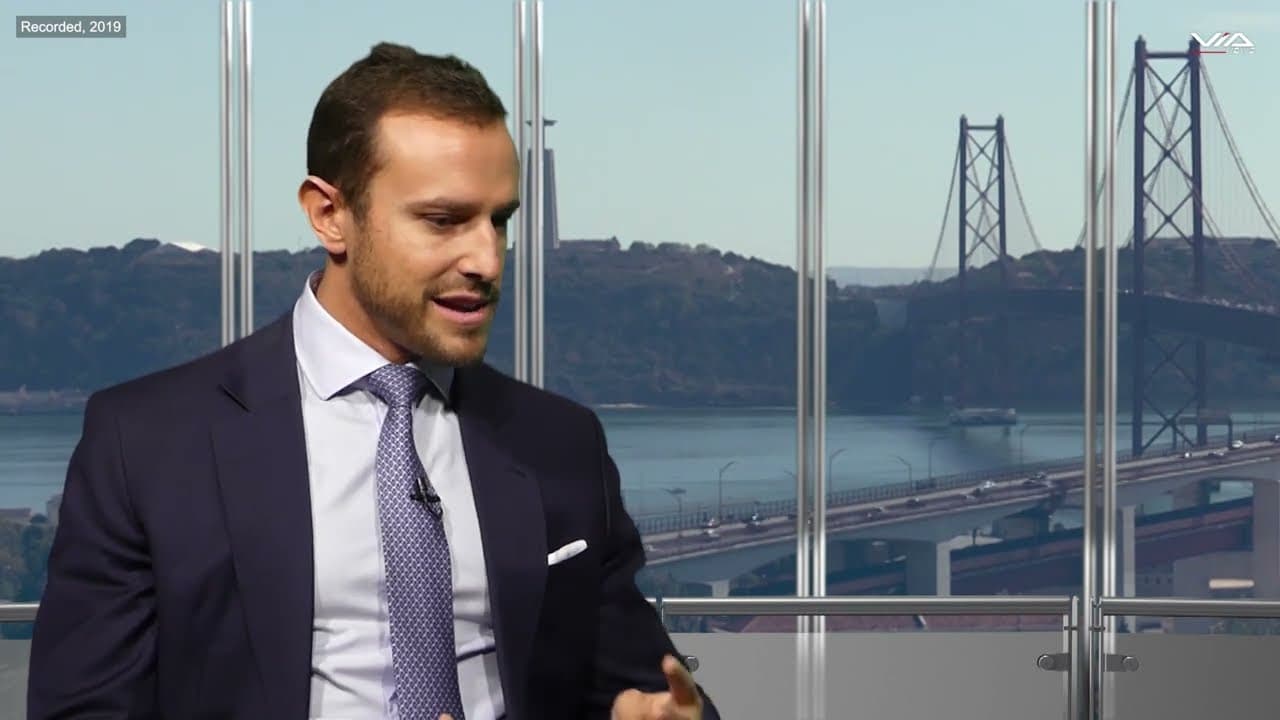
This interview was recorded about 2019.
Pedro Pinto Ferreira, CEO of Grupo Domínio Capital, believes the private equity industry has drifted from its own name, and that investors would be better served by firms that put their own money at risk. Speaking to Via News in an interview published on 7 December 2023, he said the big funds commit only a small share of their own capital and lever the rest.
"Because when we do private equity, it's actually our private equity that is being directly exposed to the businesses that we have operation in."
Ferreira described this as "a vision that probably is not the political correct one": that private equity is not exactly private equity anymore. He said that for large funds, their own share is only 5% of what they do, with the rest leveraged on investors, banks or co-investing funds. Having "skin in the game", with the firm's funds exposed directly and not leveraged, is in his view the value his group adds to the market.
From law to a family group
Ferreira began as a lawyer, graduating from the Catholic University of Lisbon and practising in London. He said he saw gaps in what law could offer his potential, so he moved into finance, took a post-graduate course at Harvard Business School and joined a private equity firm working on its first South American fund in Sao Paulo. He then returned to Portugal to lead the group his father founded 35 years earlier, which he said needed a different shape.
The group was then focused on one person, he said, with two areas of focus, real estate and infrastructure, and oil and gas, spread between Portugal and Angola. Today he describes it as a business and investment boutique with the Portuguese-speaking markets as its core geographic focus. Financial markets were added as a third sector over the past decade. It is headquartered in Lisbon with offices in Luanda, Maputo and London, and works as an adviser or direct investor.
Recession and valuations
Asked how companies should prepare for a downturn, Ferreira pointed to how the industry has changed, noting that names such as Lehman Brothers, once pillars of his field, no longer exist. He expects a recession, but not a brief one.
"I think recession is definitely something that probably will come, I'm just not certain that it will be as short as people think." He said the 2008 and 2009 crisis hit the world economy harder than earlier ones, and that the recovery since has been smooth and lacking in excitement. Companies, he said, are prudent and conservative, as shown by the cash held on their balance sheets.
He does not think the world is in a bubble. "I don't believe so. I think from what I see, the economies are growing at a normal pace." Technology valuations are high, he said, but corrections after IPOs, from Facebook to Farfetch, are the market telling companies to take it slow. Real estate may be overpriced in places, but he distinguished that from the bubble of 2008 and 2009, which he called "really something big and scary".
Portuguese-speaking markets and the next sectors
On Africa, Ferreira said his group has little exposure to exporting industries apart from oil in Angola, and that a prolonged trade war between the United States and China would hurt commodity exporters most. He said Angola must diversify away from oil, and that Mozambique must seize the moment as foreign investment arrives around its hopes of exporting gas and oil.
He said private equity has under 5% exposure to Angola and Mozambique across the continent because it needs companies with track records and audited accounts. Portugal's own private equity market is small, he said, and he expects it to concentrate on technology. On Portugal's role, he said: "I think Portugal has played on its dimension, which is limited, a very important role." Combining Portuguese expertise with cultural similarity, he said, creates an edge for both sides.
Asked about asset classes, Ferreira said his group sources deals it helps create, not allocating across classes. He named mobility and energy as unavoidable themes, saying "I think mobility within cities is something that we see a lot of change in already", and noted that a city grid could not support everyone charging electric cars at once. He also pointed to smart cities and tourism and hospitality combined with technology as areas for Portugal.
Entrepreneurship as a necessity
Ferreira said quarterly reporting is a necessity because investors no longer trust big names for their own sake and technology moves faster than earlier revolutions. On entrepreneurship, he argued it applies to every executive, from the head of a car maker to a technology company, not just founders in garages. "I don't think entrepreneurship today is an accomplishment. I think it's a necessity." He said he has to reinvent his company every day or it may not be around in a year or two.
On venture capital, he said he is not a VC specialist but struggles to understand how companies raising billions keep posting huge losses while investors continue to back them. "I think that companies should be driven by revenue. This is what gets you going."
Watch the full interview
Interview by LM Salvado (Miguel Salvado) for Via News.