
Lifting coronavirus lockdown restrictions may not by itself be sufficient to restore confidence or growth and economic recovery will start only when the pandemic is under control, according to McKinsey & Company.
"The evidence heavily suggests that a multifaceted public-health response that goes well beyond a simple transient lockdown is a necessary first step to restore confidence and create the conditions for growth," the global consulting firm wrote in a recent report.
McKinsey says only a handful of countries seem to have placed the virus under control.
Only countries that have done so are expected to be able to lift GDP to 2019's year-end level or better by the end of 2020 and most other countries are likely to experience an up to a two-year delay in economic recovery, it added.
"Countries are starting to report estimates of second-quarter GDP. Germany and the United States have registered 10.6 percent drops since the fourth quarter of 2019, while Spain and the United Kingdom have reported almost unimaginable declines of 22.7 and 22.1 percent, respectively," the report reads.
From this trough, according to McKinsey, growth would need to average 5 to 12 percent for two consecutive quarters to return GDP to the level at which it started the year.
Read more: How Has COVID-19 Affected Global Economic Sentiment?
The firm says the cost of getting the virus under control is very high but every three months of delay pushes back the return of GDP to pre-crisis levels by about six months. Time is the enemy of both lives and livelihoods.
McKinsey's study shows that the actual or expected drop in GDP through June of this year, across the Organization for Economic Cooperation and Development (OECD) countries, is not as closely correlated with the stringency or length of societal lockdowns.
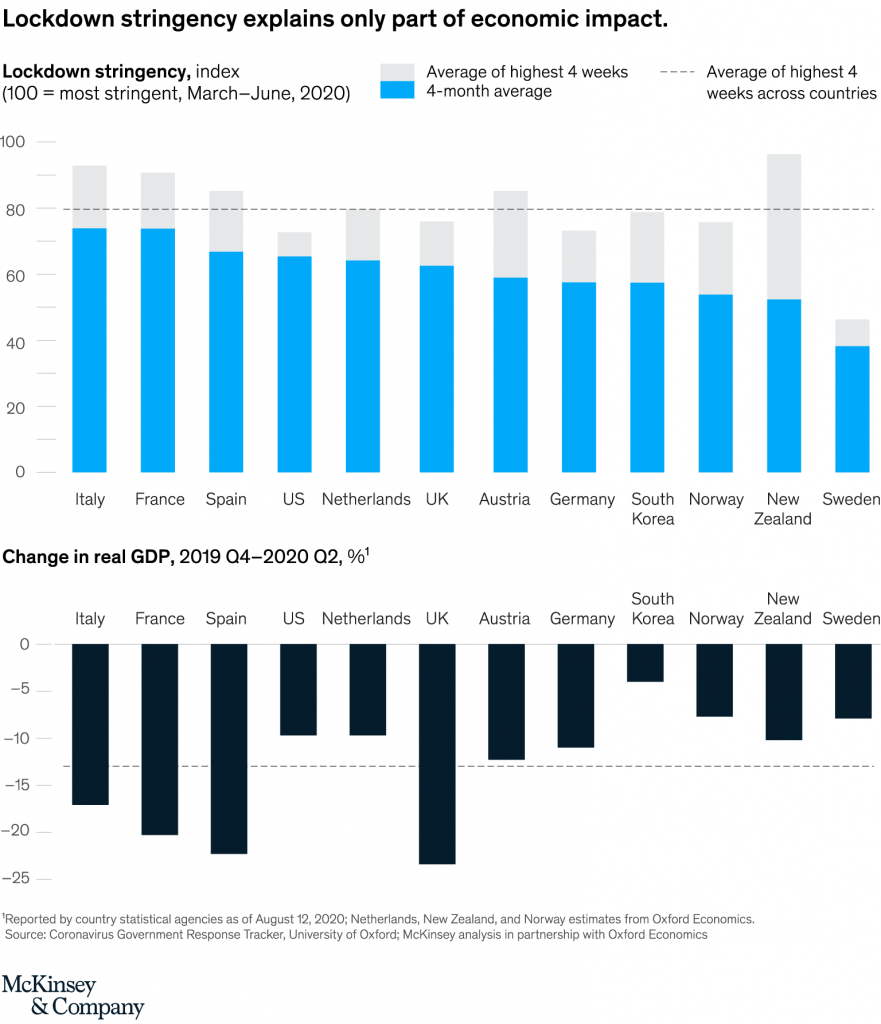
"Further, the volatility of the GDP decline in those countries is three times larger than the volatility of lockdown stringency. Variations in lockdown stringency appear to explain only part of the pandemic’s different effects on economic growth," the report noted.
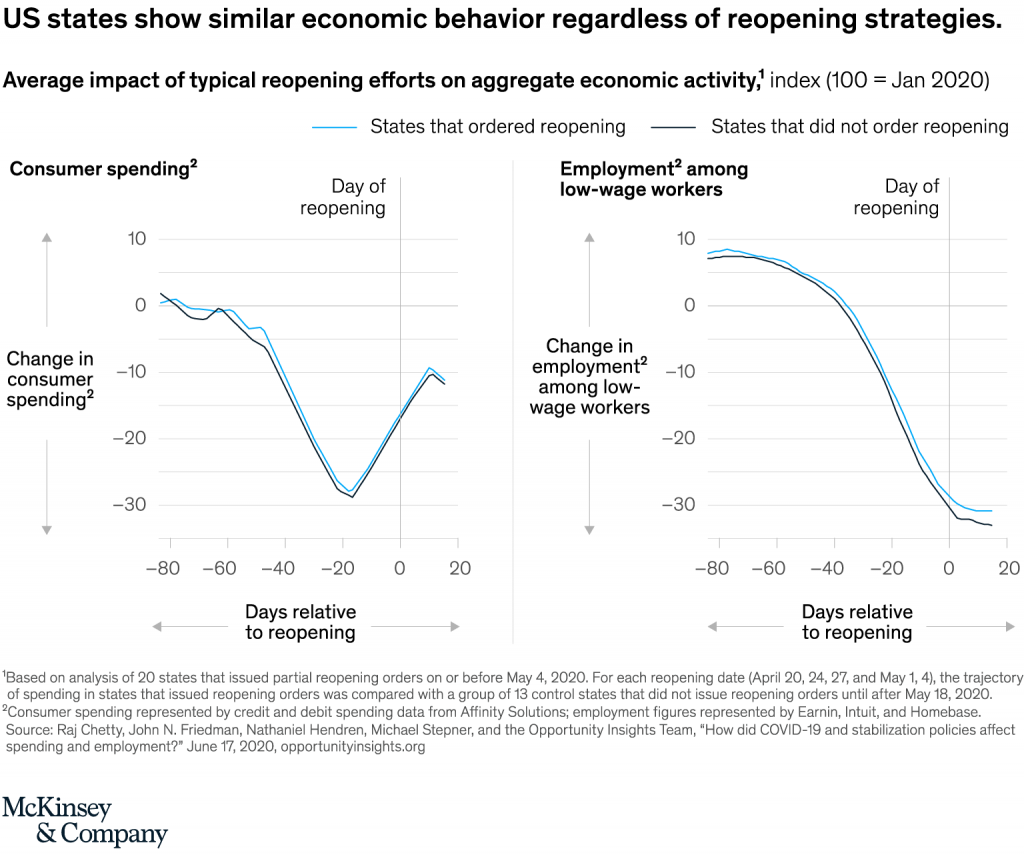
It added that detailed academic research has found no significant difference in consumer spending and employment between the U.S. states that maintained longer lockdowns versus the ones that relaxed orders early.
Confidence is Key
McKinsey's new consumer research found that more than 50 percent of consumers are "cautious" or "uncomfortable" about re-engaging in their daily routines.
"Around three-quarters of respondents are looking for structural solutions, such as COVID-19 vaccines and treatments. Only around 30 percent say they feel safer when government restrictions are lifted. Three other indicators would help, they say: seeing people wearing masks (75 percent), knowledge that the number of new cases is going down in their area (65 percent), and a determination from national public-health leaders that it is safe to reengage (56 percent)," the consulting firm reported.
McKinsey says the inescapable conclusion is that many individuals, households, and businesses have opted out of normal activity—even if no formal restrictions are in place—due to the uncertainty surrounding COVID-19 and its associated health risks.
Eliminating this uncertainty is "essential" to restart growth, it noted, adding that restoring public confidence requires "limiting the spread of the novel coronavirus" and "creating conviction that public-health measures will continue to be effective".
Getting the Virus Under Control
According to McKinsey, the public needs evidence of the following to be confident:
- Testing is sufficiently widespread for official counts, and new case counts are low.
- The number of serious cases that require hospitalization can be efficiently handled by the health system, without interrupting normal medical treatment.
- Communication about health interventions by leaders is consistent, credible, and provided sufficiently in advance to let individuals and businesses plan.
- Public-health measures are sufficient to prevent increases in transmission and delivered effectively.
- Public-health interventions do not structurally prevent economic recovery.
Read more: When Is Global Business Travel Expected to Rebound?
Costly Delay
McKinsey's observation shows that it takes about 12 weeks to enact these measures effectively.
"Countries that have restored confidence—or are close to doing so—have seen economic activity return or begin to return to pre-crisis levels," it said.
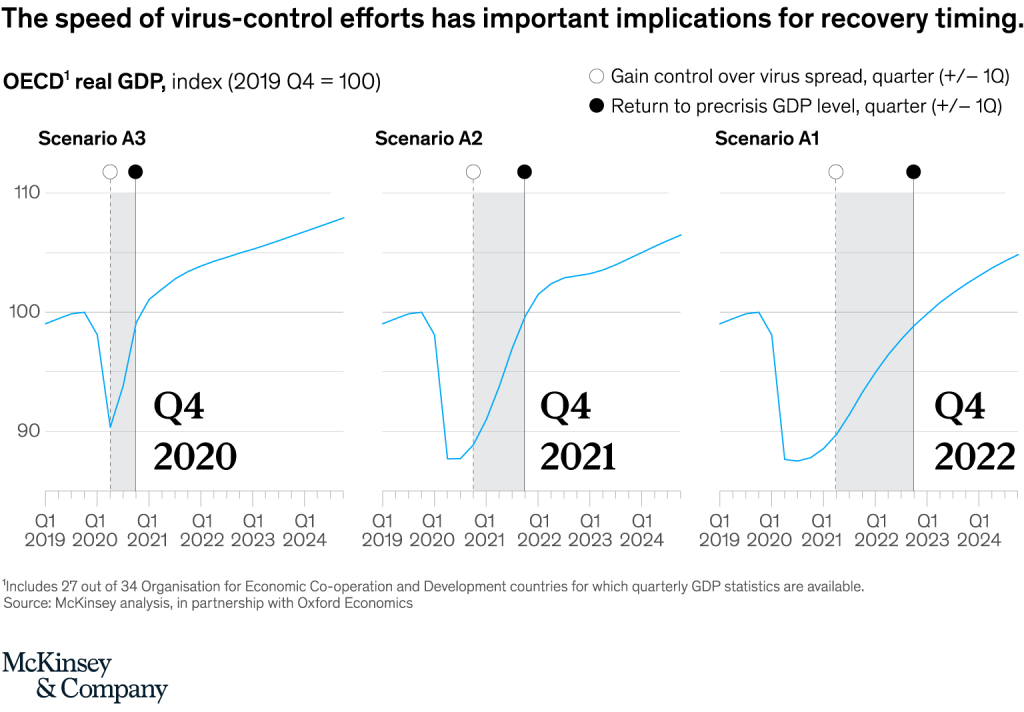
Compared with January 2020 (pre-crisis) expectations, OECD countries could lose approximately $10 trillion in cumulative GDP by 2024 if they delay in getting the virus under control, the consulting firm wrote.
"There is still time for countries pursuing a balancing-act strategy to increase their chances of achieving significantly better outcomes for lives and livelihoods," McKinsey added.